One room can smell like sewer gas when that room contains an opening between the drain system and the indoor air. The opening may be a dry fixture trap, a loose trap connection, a failed toilet seal, a damaged vent connection, a loose cleanout cap, or a cracked drain hidden behind a wall or below the floor.
An isolated odor does not automatically mean the main sewer line has failed. The location, timing, and nearby fixtures provide useful clues. A smell strongest at a floor drain suggests a different path than one concentrated around a toilet base or inside a sink cabinet.
Avoid leaning over a drain to smell it closely. If the odor is strong, causes symptoms, or could be fuel gas rather than sewer gas, leave the area and handle the situation as a safety concern.
Why the Odor Can Stay in One Room
Every sink, shower, tub, floor drain, toilet, and connected fixture should have a barrier between the drain system and the room. Most fixtures use a water-filled trap. Toilets rely on their built-in trap and a sealed connection to the drain flange. Plumbing vents balance pressure and carry drain-system air outside.
When one of those barriers fails, the odor often appears near that opening. A closed door or limited air circulation can make the smell seem more concentrated.
Air movement can also change the symptom. A bathroom exhaust fan, clothes dryer, HVAC return, or another draining fixture may lower pressure enough to pull air through a weak seal. The fan does not necessarily cause the plumbing defect; it may reveal an existing path.
The room with the strongest odor may identify the nearest escape path, not the location of the underlying defect. Air can move through wall cavities, cabinets, and floor penetrations before entering the room.
Safe Observations That Can Help Locate the Source
Keep every observation dry and external. Do not dismantle plumbing, remove a toilet, open a cleanout, climb onto the roof, or create smoke or flame inside the drain system.
From a normal standing distance, note:
- Which room and fixture area smell strongest.
- Whether the odor is near a sink cabinet, shower, tub, floor drain, toilet base, or wall.
- Whether it appears after a toilet flush, shower, sink use, or washing-machine drain cycle.
- Whether an exhaust fan or HVAC system makes it stronger.
- Whether a fixture has gone unused for an extended period.
- Whether there is visible moisture, staining, corrosion, or a gap around a drain connection.
- Whether a toilet moves during normal use or shows staining near its base.
- Whether drains in that room are slow, gurgling, or backing up.
If an accessible sink, shower, tub, or floor drain is known to have gone unused, add clean water and observe whether the odor fades. Stop if the drain rises, backs up, or leaks. Do not pour bleach, drain cleaner, oil, or fragrance into the opening.
Do not intentionally rock a toilet or tighten visible fittings as a test. Record what you see and when the odor occurs. Those details help a plumber choose the appropriate inspection method.
An Unused Fixture Trap May Have Dried Out
A P-trap holds water in a curved section of piping. That water blocks drain-system air from entering the room.
Water can evaporate from a guest-bath shower, floor drain, utility sink, or other fixture that is rarely used. Once the water seal becomes too shallow, odor can enter even though the fixture looks clean and drains normally.
Adding clean water to a known unused drain may restore the seal. If the odor disappears and stays away with normal fixture use, evaporation was a likely cause.
If the smell returns quickly, the trap may be leaking, siphoning empty, or missing a working trap-primer arrangement. A plumber should inspect the cause instead of relying on repeated refilling. There is no universal trap dry-out timeline because fixture use, indoor conditions, and the drain assembly vary.
A Trap or Fixture Connection May Be Loose
A sink can have water in its trap and still release odor through a cracked pipe, loose slip joint, failed gasket, or disconnected vent connection. The drain may continue carrying water, so there may be no obvious backup.
Look for visible gaps, staining, moisture, or corrosion inside the cabinet without touching the piping. An odor strongest beneath the sink, especially after water runs, supports a local connection problem but does not identify the exact fitting.
Bathtubs, showers, washing-machine standpipes, and floor drains also have concealed connections that can loosen or deteriorate. If the source seems to be inside a wall or below the floor, do not open finishes or insert tools into the drain. A targeted plumbing inspection can locate the path before repair work begins.
The Toilet Seal May No Longer Be Airtight
A toilet connects to the drain through a flange and sealing ring. That seal can fail even when the toilet still flushes.
Odor may be strongest at the toilet base. Other clues include staining, moisture after flushing, or movement noticed during normal use. A toilet can also release drain-system air without producing an immediately visible water leak.
Do not caulk over a suspected opening to trap the smell, and do not keep using a toilet that visibly leaks or shifts. Covering the symptom does not repair the connection and can conceal moisture. A plumber may need to remove the toilet so the seal, flange, and surrounding floor can be evaluated.
A Plumbing Vent Problem Can Pull Odor Indoors
The vent system balances pressure as wastewater moves through the drains. A blocked roof termination, cracked vent, loose fitting, or disconnected pipe can allow odor into a room or pull water out of a nearby trap.
Vent trouble becomes more plausible when the smell changes as toilets flush, a large volume of water drains, or exhaust equipment operates. Gurgling at a nearby fixture can add context, but it does not identify the defect.
Do not climb onto the roof, insert tools into a vent, or seal a vent opening. A concealed crack may be inside a wall or attic rather than at the roof termination.
A Concealed Drain or Sewer Defect May Be Leaking Air
A cracked drain, separated joint, loose cleanout cap, damaged branch connection, or abandoned pipe opening can release drain-system air without leaking visible wastewater at all times.
The odor may collect near a wall, cabinet, floor penetration, or utility chase. It may become stronger when an upstairs fixture drains or when the home’s air pressure changes. Moisture, insects, or staining can accompany the problem, but their absence does not rule it out.
A defect behind finished surfaces should be located before walls or flooring are opened. Guessing can lead to unnecessary demolition while leaving the actual escape path untouched.
When Smoke Testing Fits an Odor Isolated to One Room
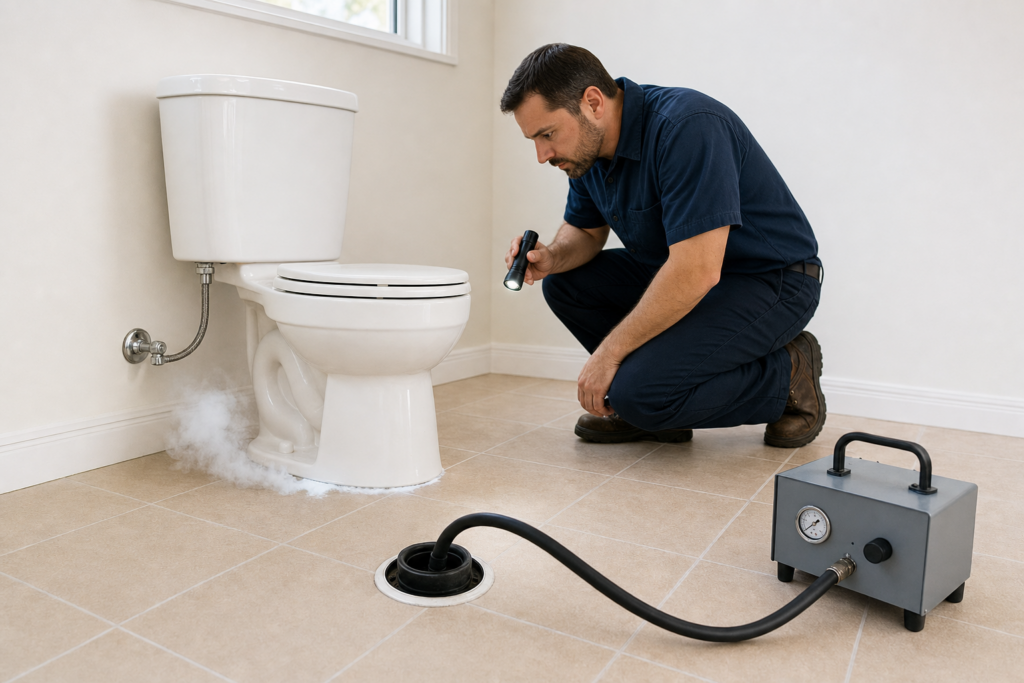
Smoke testing is useful when the smell points to a room or fixture group but the opening cannot be seen during a normal inspection. The test looks for the path through which drain-system air can escape.
A professional test may reveal diagnostic smoke at a failed toilet seal, loose fitting, damaged vent, cracked pipe, open cleanout, or another unintended opening. Visible smoke identifies an escape path; it does not automatically prove the condition of every connected pipe or establish the complete repair by itself.
Smoke testing is not automatically required for every dry drain. If an unused trap is dry and the odor resolves after its water seal is restored, the source may already be clear. Testing becomes more useful when:
- The odor returns after accessible traps are refilled.
- One room smells despite every nearby fixture being used regularly.
- The smell appears near a wall or floor rather than directly at a drain.
- A toilet seal or vent defect is suspected but not visible.
- The odor changes with fans, flushing, or other fixture use.
- A prior focused repair did not correct the symptom.
The Sewer Brothers provides smoke testing in the San Fernando Valley when a suspected escape path needs to be located before a repair is planned.
Smoke Testing and Sewer Camera Inspection Answer Different Questions
Smoke testing looks for an opening through which drain-system air escapes. A sewer camera looks inside an accessible pipe for conditions such as a break, separation, obstruction, root intrusion, or deformation.
A camera may help when the odor appears with recurring clogs, slow drains, backups, or suspected sewer damage. It may not reveal a failed toilet seal or an opening in a concealed vent because those defects can be outside the camera’s view or on another branch.
The methods can complement each other. A smoke test may locate the room-level escape path, while a sewer camera inspection can evaluate the inside of a connected drain or sewer line when the other symptoms support that need.
When to Leave the Area or Stop Using a Fixture
Leave the affected area and get fresh air if the odor is strong or anyone develops headache, dizziness, drowsiness, nausea, eye irritation, or breathing discomfort. Seek medical guidance for symptoms. If a high concentration is suspected in an enclosed space, evacuate the building and contact the fire department from outside. Wisconsin public-health guidance also advises avoiding ignition sources when a high concentration may be present.
Do not assume the air is safe simply because the smell fades. CDC/NIOSH guidance warns that the sense of smell cannot reliably indicate the continued presence of hydrogen sulfide.
If the odor could be fuel gas, leave without operating switches, appliances, matches, lighters, or other potential ignition sources. Contact the gas utility or fire department from a safe location.
Stop using an individual fixture when:
- A toilet shifts, leaks, or smells strongly at its base.
- A sink trap or drain connection visibly leaks.
- Water backs up or rises instead of draining.
- Odor becomes sharply stronger whenever that fixture is used.
- Wastewater or sewage is visible.
Closing the room temporarily is not a repair. Arrange an inspection before returning the affected fixture to normal use.
What a Plumber May Check
A plumber should begin with the affected room and the reported pattern rather than assuming the main sewer is responsible. The inspection may include:
- Confirming water in accessible fixture traps.
- Checking visible trap and drain connections.
- Evaluating the toilet base, seal, and flange condition.
- Looking for loose cleanout caps or abandoned openings.
- Checking whether drainage changes trap water levels.
- Assessing vent behavior.
- Determining whether smoke testing can isolate a concealed air path.
- Recommending camera inspection only when pipe-interior symptoms support it.
The finding may lead to a trap correction, fixture-seal replacement, vent repair, concealed drain repair, or further sewer evaluation. The source should be located before broader work is recommended.
Request Help for a Recurring Sewer Odor
An odor that returns after a dry trap is refilled, concentrates around a toilet, or seems to come from a wall or floor deserves a focused plumbing inspection. The Sewer Brothers can evaluate the room, nearby fixtures, venting, and drain connections and determine whether smoke testing is the appropriate next step.
San Fernando Valley homeowners can contact The Sewer Brothers. For fixture or household piping problems outside the sewer system, review available residential plumbing services.
Frequently Asked Questions
Can a dry drain make only one room smell?
Yes. If one floor drain, shower, tub, or sink trap loses its water seal, drain-system air may enter through that fixture. The odor can remain concentrated in the room, especially when the door is closed or an exhaust fan changes air pressure.
Why does the sewer smell get stronger when the bathroom fan runs?
The fan may lower air pressure in the room and draw air through a dry trap, weak toilet seal, loose drain connection, or vent defect. The fan reveals the path; it does not necessarily create the plumbing problem.
Can a toilet release sewer gas without leaking water?
Yes. A failed toilet seal can release drain-system air while allowing little or no visible water to escape. Odor at the base, staining, or movement during normal use supports inspection of the seal and flange.
Will a sewer camera find the source of every odor?
No. A camera shows the inside of an accessible pipe. It may find a broken or separated line, but it may not reveal a failed fixture seal, loose cleanout cap, or vent opening. Smoke testing is often better suited to locating an escaping-air path.
Is smoke testing needed after I refill a dry trap?
Not necessarily. If refilling the trap eliminates the odor and it does not return, the cause may already be clear. Smoke testing becomes more useful when the smell persists, returns quickly, or appears to come from a concealed location.