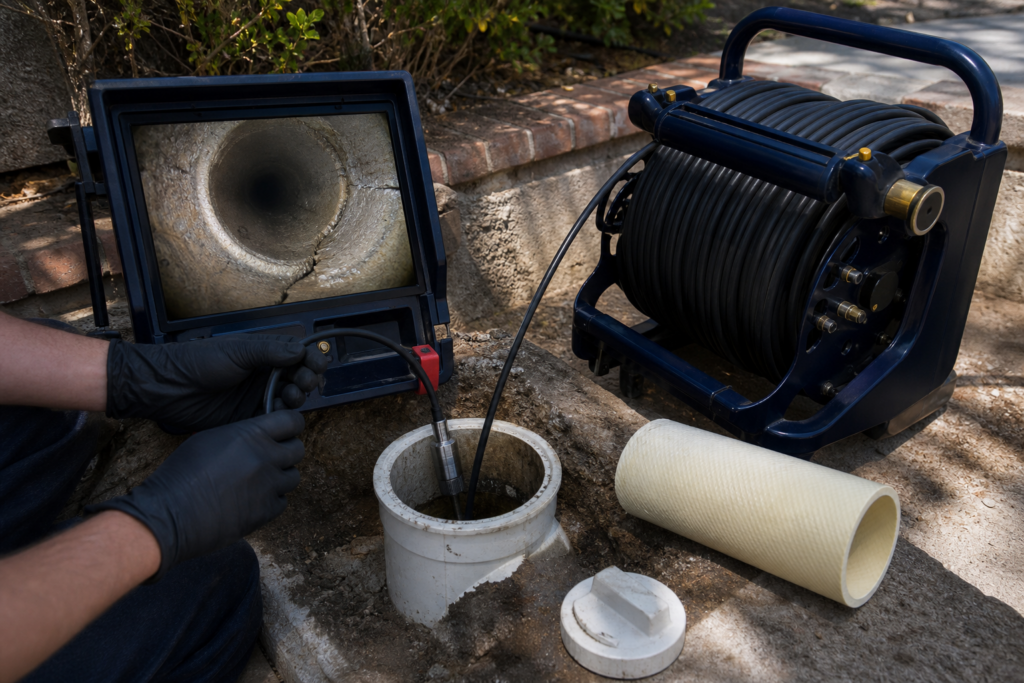
Plumbers determine whether a sewer line can be relined by cleaning it, inspecting the full run with a camera, measuring the pipe, and confirming that the old line still provides a continuous host for the new liner. Cracks, worn joints, and some root-entry points may be compatible with lining. A fully collapsed, missing, severely offset, or badly deformed section may need excavation or another repair first.
No single camera snapshot is enough. The evaluation must account for the route, pipe material, diameter, access, bends, branch connections, and grade.
The First Camera Inspection Locates the Problem
An initial sewer-camera inspection can show where the line is blocked or damaged. It may reveal roots, cracks, separated joints, corrosion, scale, deformation, or standing water.
Heavy buildup can hide the pipe wall, so this first look does not always settle the lining decision. It helps the plumber plan safe cleaning and identify sections that may need special attention.
Cleaning Reveals the Actual Host Pipe
A liner needs a prepared surface and a clear path. Roots, grease, deposits, and loose scale must be addressed with a method appropriate for the pipe material and condition.
After cleaning, another camera pass shows what remains. The plumber can see whether the apparent obstruction was removable buildup or structural damage. Cleaning may reveal a crack, offset, hole, or missing section that was not visible before.
The post-cleaning inspection also confirms whether equipment can travel the intended run and whether the interior is ready for accurate measurements.
The Pipe Must Remain Continuous
Relining forms a new pipe inside the existing one. The old pipe therefore needs to maintain enough shape and continuity to support installation.
Conditions that may be compatible with lining, depending on their severity and the selected system, include:
- Cracks that have not caused a full collapse.
- Worn or leaking joints.
- Surface corrosion or deterioration.
- Root-entry points after roots are removed.
- Small gaps that do not interrupt the installation path.
Conditions that may prevent direct lining include a missing pipe section, a complete collapse, a severe offset, or deformation that leaves too little opening. A liner cannot restore a pathway where the host pipe no longer provides one.
Grade and Bellies Need Separate Attention
A liner follows the route of the host pipe. It does not normally change the line’s slope or lift a sagging section. If the camera and measurements show a belly that holds water, lining may improve the pipe surface without correcting the grade problem.
The plumber must determine whether standing water comes from a temporary blockage or the physical slope of the line. A grade defect may require excavation and repositioning rather than lining alone.
Diameter and Length Must Be Measured
The liner is selected for a specific inside diameter and repair length. The plumber confirms pipe size, transitions, and the exact distance between access points.
Unexpected diameter changes, irregular repairs, or connections between different pipe materials can affect the installation plan. Accurate measurements are also needed so the liner reaches the intended limits without blocking another fitting.
Bends and Connections Affect the Plan
Sewer lines can include changes in direction and branch connections. The inspection records the number and sharpness of bends and identifies active laterals.
Some lining systems can pass through common bends, but multiple tight turns or unusual fittings may restrict access. Active connections must remain functional. The repair plan should explain how each connection will be protected or reopened after the liner is installed.
Access Must Support Every Step
Suitable access is needed for cleaning, camera inspection, liner placement, curing, and final verification. Existing cleanouts may provide that route. If they do not, a controlled access point or small excavation may be needed.
Limited access does not always rule out lining, but it changes the scope. Equipment must be placed safely, and the liner must be installed without forcing it through an unknown obstruction.
A Sectional Repair Can Make the Rest Lineable
A single collapsed or severely offset section does not necessarily mean the entire sewer must be excavated. The plumber may recommend repairing that section first, then reevaluating the remaining run for lining.
This mixed approach depends on the location of the defect, access, overall condition, and the ability to prepare the rest of the pipe. The recommendation should be based on documented findings rather than an assumption that one method fits the entire line.
What the Final Recommendation Should Explain
A clear evaluation should identify:
- Pipe material, diameter, and measured length.
- The location and severity of each defect.
- Cleaning performed and remaining pipe condition.
- Bends, connections, and access points.
- Whether grade or standing water affects the repair.
- Which sections are suitable for lining.
- Which sections, if any, need another repair method.
- How the finished work will be inspected.
That evidence allows the property owner to compare relining, targeted excavation, and replacement based on the actual sewer condition.
Schedule a Sewer-Line Evaluation
If you are considering trenchless pipe lining in the San Fernando Valley, contact The Sewer Brothers for a sewer evaluation. Cleaning, camera inspection, measurements, and access review can show whether the line is suitable for relining or whether another repair should address part of the system first.